To Expose the Atrocity Crimes by French Cameroun on the people of British Southern Cameroon.
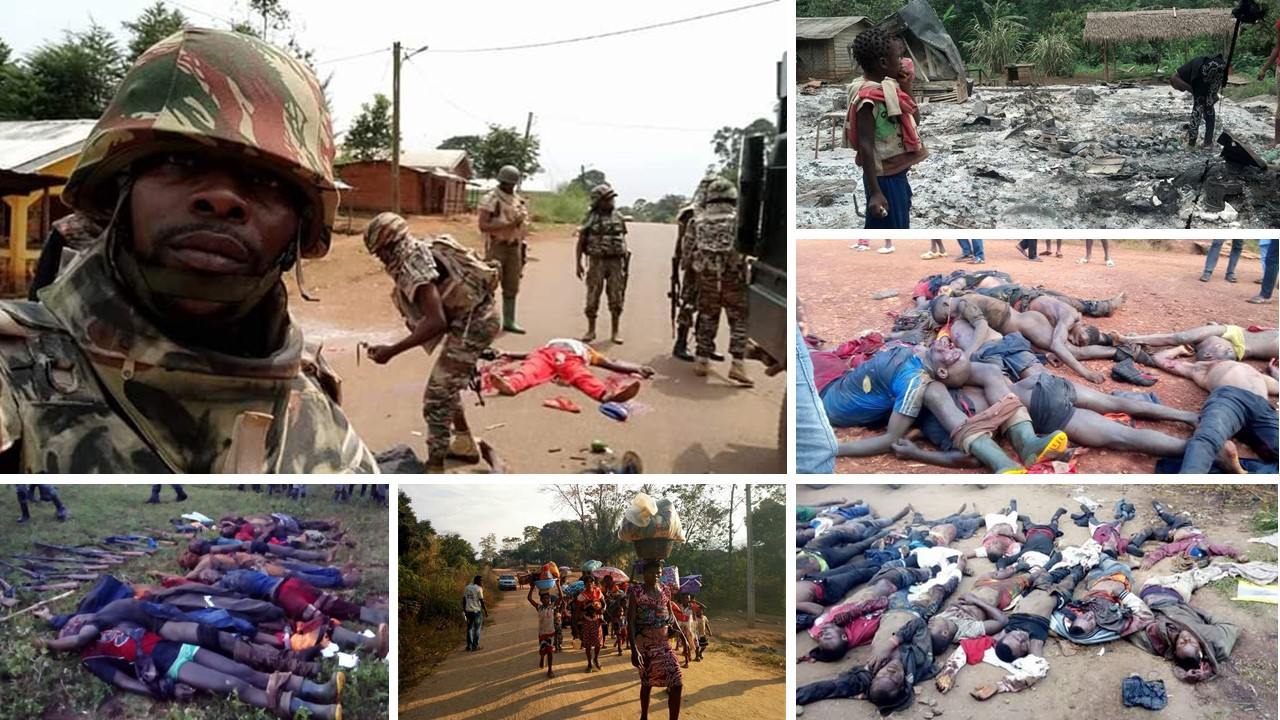
Cameroon Begins Failing Pope Leo XIV’s Moral Test 10 Days After: Jakiri’s Bloodshed and the Collapse of Restraint After a Global Call for Peace
Colbert Gwain | The Muteff Factor (formerly The Colbert Factor)
In Muteff, elders tell of a day the marketplace was mistaken for a battleground. Word had spread that a fugitive was hiding among traders. Armed men arrived without warning, surrounding the square where women sold beans and children chased one another between stalls. By the time the confusion cleared, the fugitive was gone—but the marketplace lay in mourning. “We found no criminal,” an elder would later say, “only the cost of searching for him the wrong way.”
That memory now echoes in Jakiri.
If confirmed, the incident raises grave concerns under International Humanitarian Law—particularly the principles of distinction and proportionality. These are not abstract ideals; they are binding rules designed precisely for moments like this. Even when pursuing legitimate targets, parties to a conflict must distinguish civilians from combatants and must not inflict harm that is excessive in relation to the anticipated military advantage.
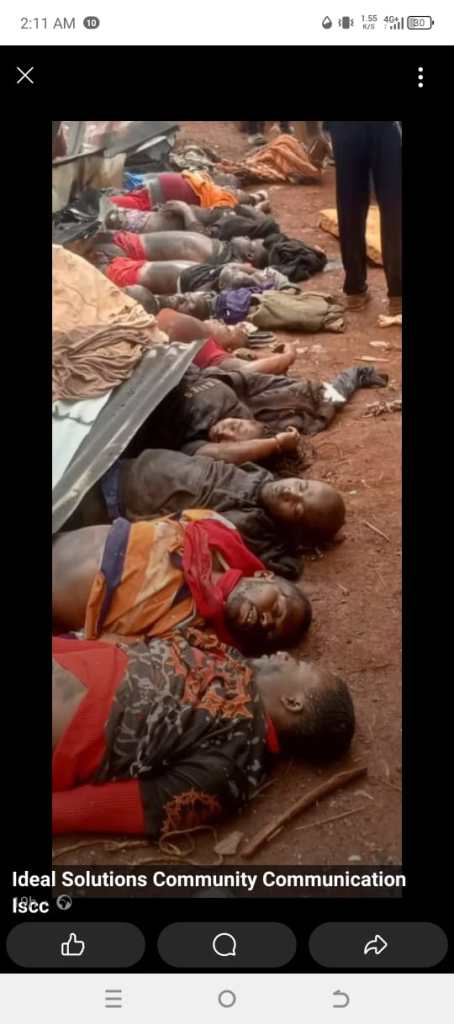
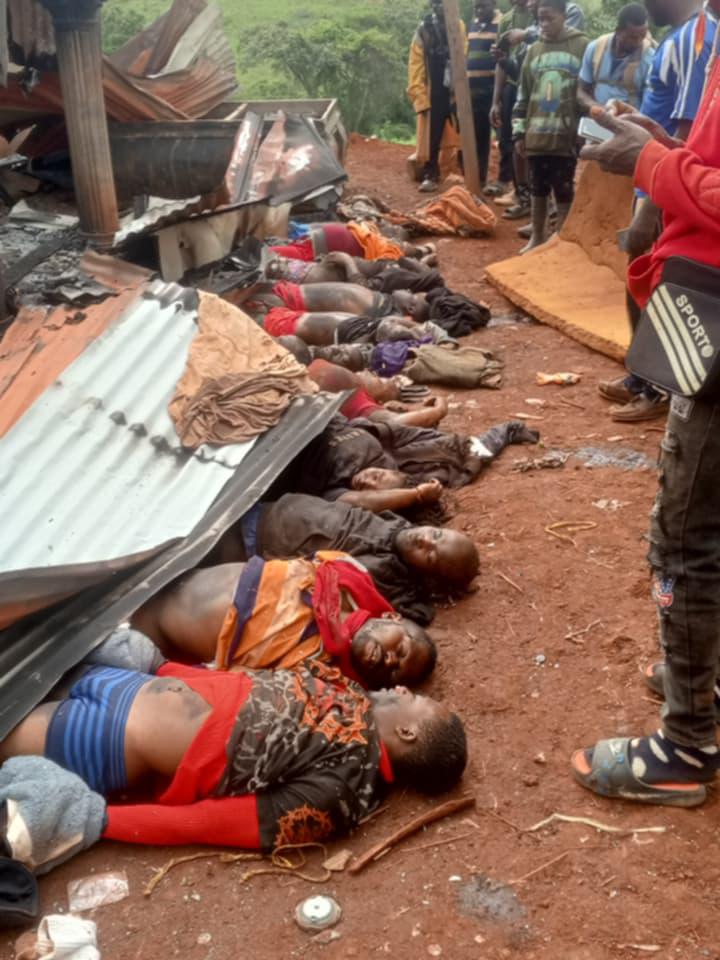
Credible local reports indicate that villagers had gathered at the Fon’s Palace for a cultural festival—an event rooted in identity and continuity. Before the celebration could fully unfold, security forces reportedly stormed the venue, allegedly acting on intelligence that separatist fighters were present. In the aftermath, at least 15 people were said to have been killed, many labeled as suspected fighters .
It is here that a deeper moral tradition, long embedded in law and conscience, becomes impossible to ignore. As William Blackstone famously argued, “it is better that ten guilty persons escape than that one innocent suffer.” The principle is simple, but its implications are profound: the preservation of innocent life must outweigh the urgency of punishing the guilty.
Jakiri appears to invert that principle.
To strike a crowded cultural gathering on the suspicion that armed elements may be present is to accept, in advance, the likelihood that innocent lives will be lost in the process of targeting the guilty. It is to choose certainty of civilian harm over the risk of letting suspects evade capture—and in doing so, it crosses the very moral line that both law and conscience are meant to defend.
What gives this moment even sharper moral urgency is its timing.
Pope Leo XIV stood in Bamenda on April 16, 2026, issuing a direct appeal to conscience: restraint, accountability, and the protection of human dignity in the conduct of conflict. Ten days later—on April 26, 2026—the reported carnage in Jakiri unfolded.
Ten days.
Not months of fading memory or diluted resolve, but a matter of days—barely enough time for the echo of that message to leave the hills of the North West Region. The proximity is not incidental; it is indicting. It transforms what might have been seen as routine tragedy into a direct test of whether that moral call carried any operational weight.
Yet Jakiri suggests the opposite.
Early reactions from segments of the international and faith-based press—including outlets such as The Wall Street Journal, National Catholic Reporter, and Vatican News—increasingly frame the Anglophone crisis as a test of moral leadership, not merely a question of territorial control. Incidents like this risk reinforcing a perception that calls for peace are acknowledged in speech but disregarded in action.
There will, as always, be explanations.
Intelligence pointed to a threat. Armed actors embedded within civilian spaces. The urgency of neutralizing danger. But explanations are not exonerations. If anything, they heighten the obligation to act with precision and restraint.
Not whether force can be justified—but whether it can be limited. Not whether enemies can be pursued—but whether civilians can be protected. Not whether authority can be asserted—but whether it can be exercised with discipline.
Because this is the essence of the test now before Cameroon.
Jakiri suggests that, in this moment, that discipline faltered.
And the cost is not measured only in lives lost. When a Fon’s Palace—custodian of culture and community—becomes a site of violence, something deeper is broken. The invisible boundary that once separated civilian life from the machinery of war begins to disappear.
If there is to be any recovery from this moment, it must begin with truth: a transparent investigation, accountability where violations are found, and concrete safeguards to ensure that civilian spaces are never again treated as expendable.
Anything less will confirm what Jakiri already suggests: that the call for peace by Pope Leo was heard, but not heeded.
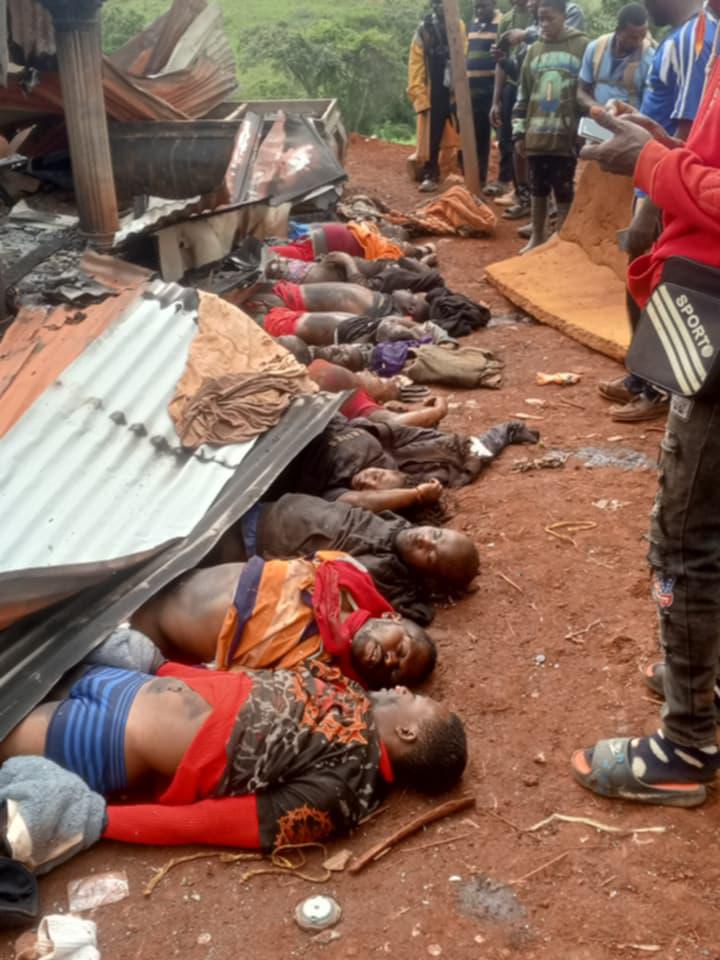
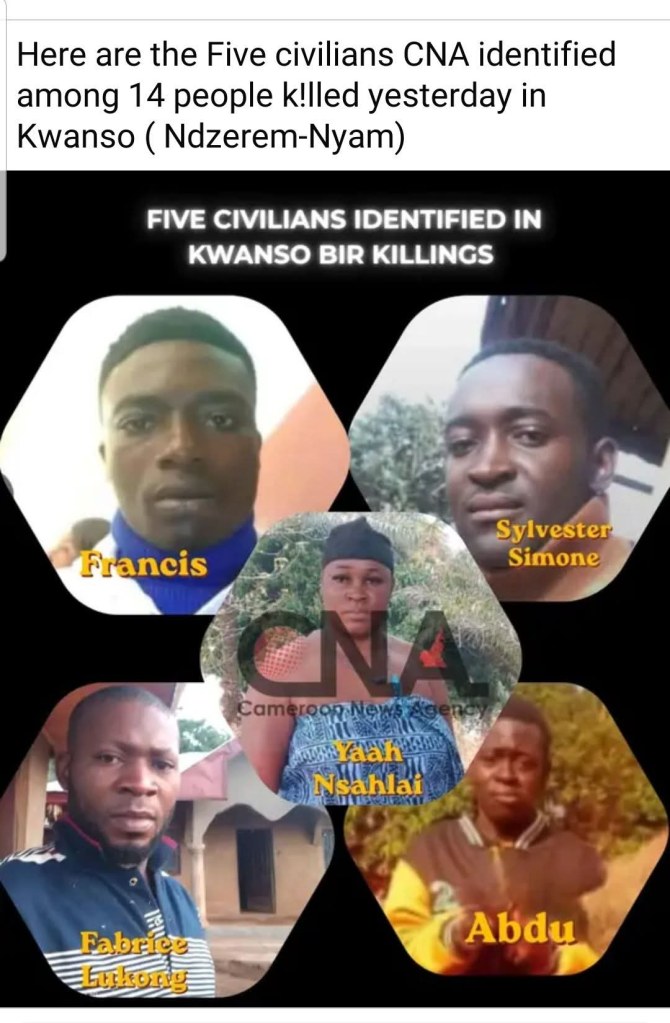
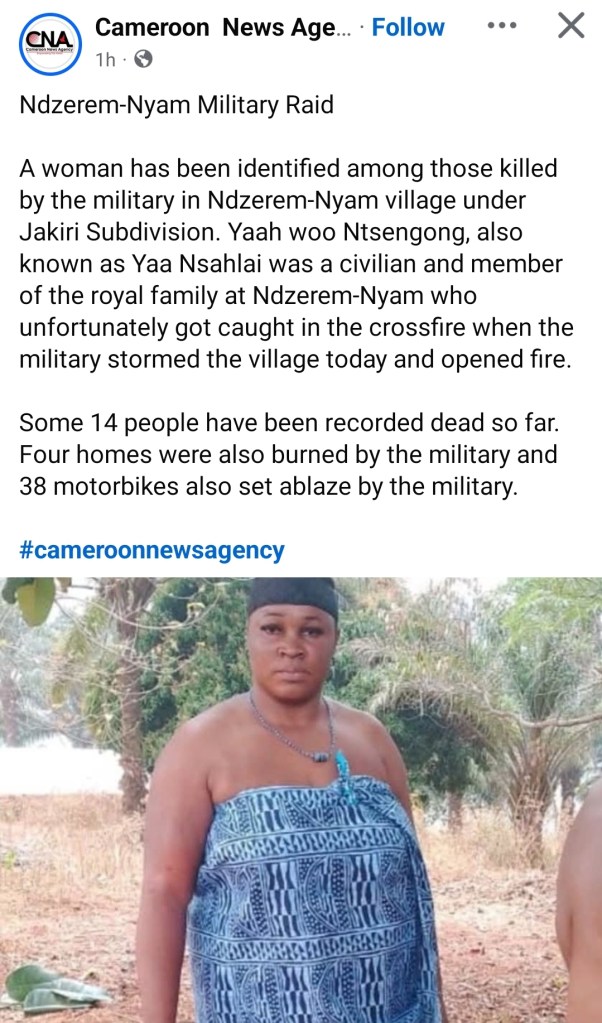
The individuals were at a traditional celebration on 26 April 2026, when the Biya thugs invaded the ceremony in search of Ambazonian Liberation Soldiers. Not seeing any soldiers their anger was unleashed on the cuvilians at the ceremony. To dilute popluc opinion, the French Cameroun soldiers then used old pictures and edited(photoshop) them to include weapons to claim the civilians were Ambazonia fighters. Details later. Thr colonial soldiers also burnt homes and motorbikes. Below are images of some of the individuals identified as the other families are too scared to acknowledge their killed lived ones for fear of the military coming back to kill them. Full details later.

With their chief correspondent in Yaounde as one of the main propagandist on state television – Cameroon Radio and Television (CRTV), the Voice of America has practically been an extended mouthpiece of the Cameroun government, rebroadcasting the same half-baked facts to the world. This has been the case with the ongoing genocide against the minority English-speaking people (Ambazonia). The latest lies from the VOA, is a report where a brutal attack on the French Cameroun colonial forces by the Ambazonian Liberation Soldiers, is blamed on Fulanis from Taraba State in Nigeria. The VOA in quoting the French Cameroun Military accuses writes:
Akwaya is a village in the Southern section of English Cameroon(Ambazonia) and shares a boundary with Cross River State in Nigeria, not Taraba state. Taraba State shares a boundary with the Northern Part of Ambazonia. By VOA’s reporting, the Fulanis would have had to cross Benue state into Cross River state in Nigeria then to Akwaya in English Cameroon(Ambazonia). The propaganda from the French Cameroun government is aimed at deceiving the international community that the civil war in the country has ended, which is far from the truth. Daily, the Ambazonian soldiers are inflicting heavy losses on the demoralized French Cameroun soldiers, who continue to die in a senseless war from octogenarians in Yaounde. Our research is still to identify a river in Nigeria called Moon. We equally asked Chat GPTU
The accusation of Nigerian Fulanis is equally aimed at encouraging the Tinibu administration to continue its abuse of the rights of Ambazonian refugees in nigeria, where in addition to arresting them and sending them to the brutal government in Yaounde, many are being killed with the help of Nigerian insiders who facilitate passage of the French Cameroun soldiers into the refugee camps
A credible negotiation process must include: Negotiations between legitimate belligerent parties, – Representation connected to homeland self-defense realities through designated diplomatic structures, – Neutral third-country venue, –International mediation, – Binding guarantors,-Unified institutional representation, – Immediate humanitarian measures, – No predetermined political outcome.
By The International/Diplomatic Spokesperson
A close examination of the memorandum attributed to Mr. Chris Anu reveals that, while it raises certain humanitarian concerns, it diverges in critical respects from the official negotiation posture of the Federal Republic of Southern Cameroons – Ambazonia (FRSC–Ambazonia) and from the diplomatic framework under which homeland self-defense forces are represented internationally.
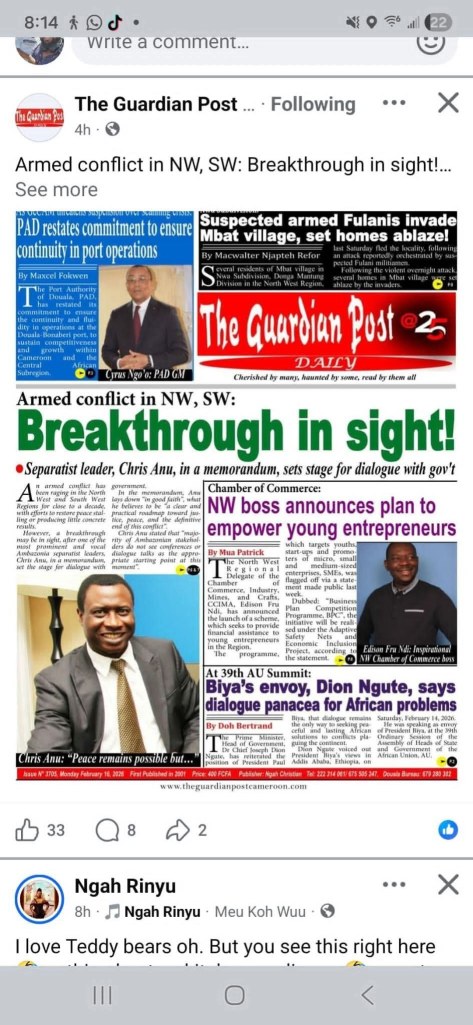
This critique clarifies the distinction between personal advocacy and institutional negotiating positions, particularly regarding representation, belligerent status, negotiation structure, and mediation guarantees.
Representation and Mandate
The FRSC–Ambazonia position maintains that negotiations concerning the conflict must involve constitutionally and institutionally mandated representatives of the people of Southern Cameroons, including political authorities and recognized representatives connected to realities on the ground.
Mr. Chris Anu presently holds no official mandate within recognized government or diplomatic structures to negotiate or speak on behalf of the state or the population in matters of political settlement.
In contrast, the internationally engaged diplomatic posture of FRSC–Ambazonia recognizes that self-defense forces operating in the homeland, being directly affected by and involved in the conflict, must have their perspectives represented through designated international or diplomatic spokesperson structures, rather than through private initiatives. The memorandum therefore risks creating confusion by suggesting representation where institutional authority is absent.
Negotiations Must Occur Between Belligerents
Under established international conflict-resolution norms, negotiations occur between belligerent parties, meaning actors directly engaged in the conflict. In the present conflict, the belligerents consist of:
The State of Cameroon; and Forces and institutions representing Southern Cameroons/Ambazonia, including homeland self-defense forces and the political structures representing the people. Mr. Chris Anu is not himself a belligerent actor, nor does he exercise command or political authority over forces operating in the homeland.
Therefore, he cannot sit at the negotiation table as a negotiating party. Legitimate negotiations must occur between recognized representatives of the conflicting parties, including designated diplomatic representatives connected to homeland realities.
Necessity of Negotiations in a Neutral Third Country
The memorandum proposes dialogue but does not sufficiently emphasize that negotiations must occur: In a neutral third country, Outside the territorial control of either belligerent, Under conditions guaranteeing safety and equality of participation.
The FRSC–Ambazonia position insists that negotiations cannot credibly occur within the territory of one belligerent, as this creates power imbalance and undermines trust. International precedents demonstrate that neutral venues are essential for credible peace negotiations.
Need for an International Guarantor
The memorandum places emphasis on sincerity but does not sufficiently address the need for binding international guarantees. The position of FRSC–Ambazonia maintains that any negotiated settlement must include:
Credible international guarantors, Monitoring mechanisms, Enforcement frameworks ensuring compliance. Peace agreements that rely solely on goodwill have historically collapsed without enforceable guarantees.
Premature Narrowing of Political Outcomes
The memorandum advances autonomy followed by a referendum as a starting compromise. However, the official negotiation posture of FRSC–Ambazonia maintains that:
Negotiations should not begin with predetermined outcomes, All political options must remain open during negotiations, Final arrangements must result from structured negotiation processes and popular consultation. Predefining outcomes risks constraining negotiation space and undermining stakeholder participation.
Risk of Diplomatic Fragmentation
Uncoordinated proposals from individuals risk: Confusing international mediators, Encouraging divide-and-rule approaches, Weakening unified diplomatic representation. The official position emphasizes coherent diplomatic messaging through recognized institutions and designated spokespersons.
Strategic Conclusion
Humanitarian Measures Versus Political Negotiation
The memorandum correctly highlights urgent humanitarian issues, including detainees and displaced populations. However, FRSC–Ambazonia distinguishes between: Immediate humanitarian obligations that must proceed without conditions, and Political negotiations addressing long-term settlement. Humanitarian relief must not substitute for structured political negotiations.
Mr. Chris Anu’s memorandum highlights humanitarian concerns but remains institutionally misaligned with the official negotiation posture of the Federal Republic of Southern Cameroons – Ambazonia.
Key deficiencies include:
Lack of negotiation mandate, – Absence of belligerent status, – Insufficient insistence on neutral third-country negotiations, – Failure to demand international guarantors, – Premature narrowing of political outcomes, – Risk of diplomatic fragmentation.
Negotiation Framework of FRSC–Ambazonia (Summary)
A credible negotiation process must include: Negotiations between legitimate belligerent parties, – Representation connected to homeland self-defense realities through designated diplomatic structures, – Neutral third-country venue, –International mediation, – Binding guarantors,-Unified institutional representation, – Immediate humanitarian measures, – No predetermined political outcome.
The International/Diplomatic Spokesperson
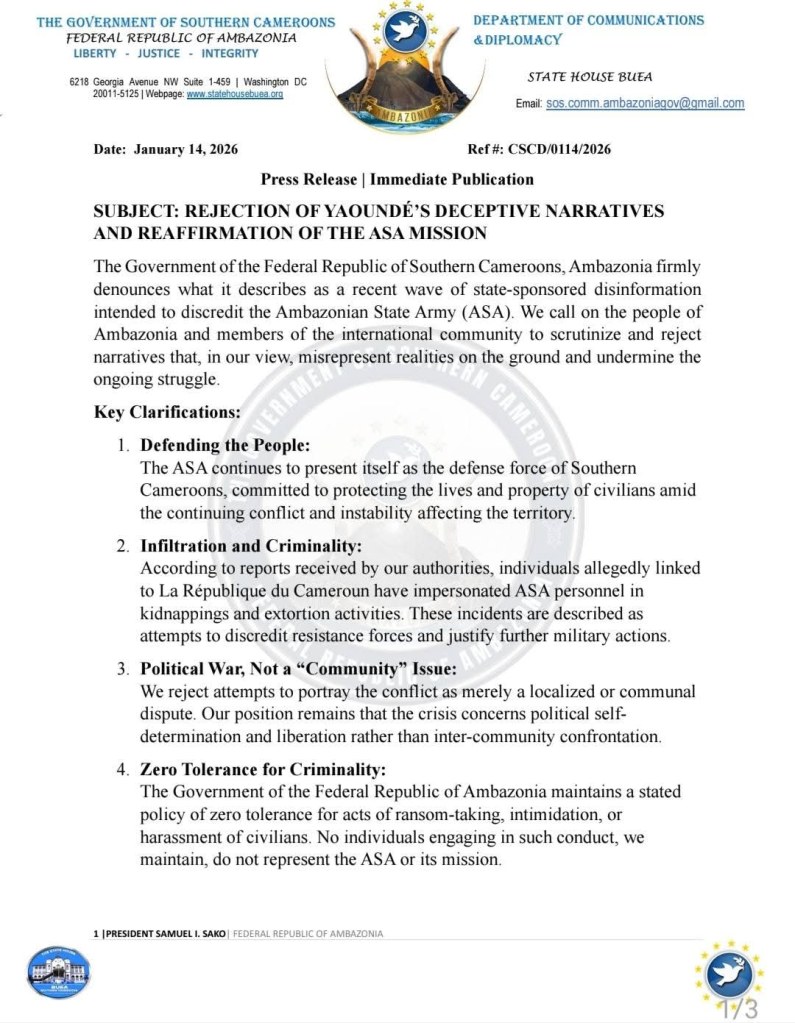
Date: January 14, 2026 Ref #: CSCD/0114/2026
Press Release
SUBJECT: REJECTION OF YAOUNDÉ’S DECEPTIVE NARRATIVES
AND REAFFIRMATION OF THE ASA MISSION
The Government of the Federal Republic of Southern Cameroons, Ambazonia firmly denounces what it describes as a recent wave of state-sponsored disinformation intended to discredit the Ambazonian State Army (ASA). We call on the people of Ambazonia and members of the international community to scrutinize and reject narratives that, in our view, misrepresent realities on the ground and undermine the ongoing struggle.
Key Clarifications:
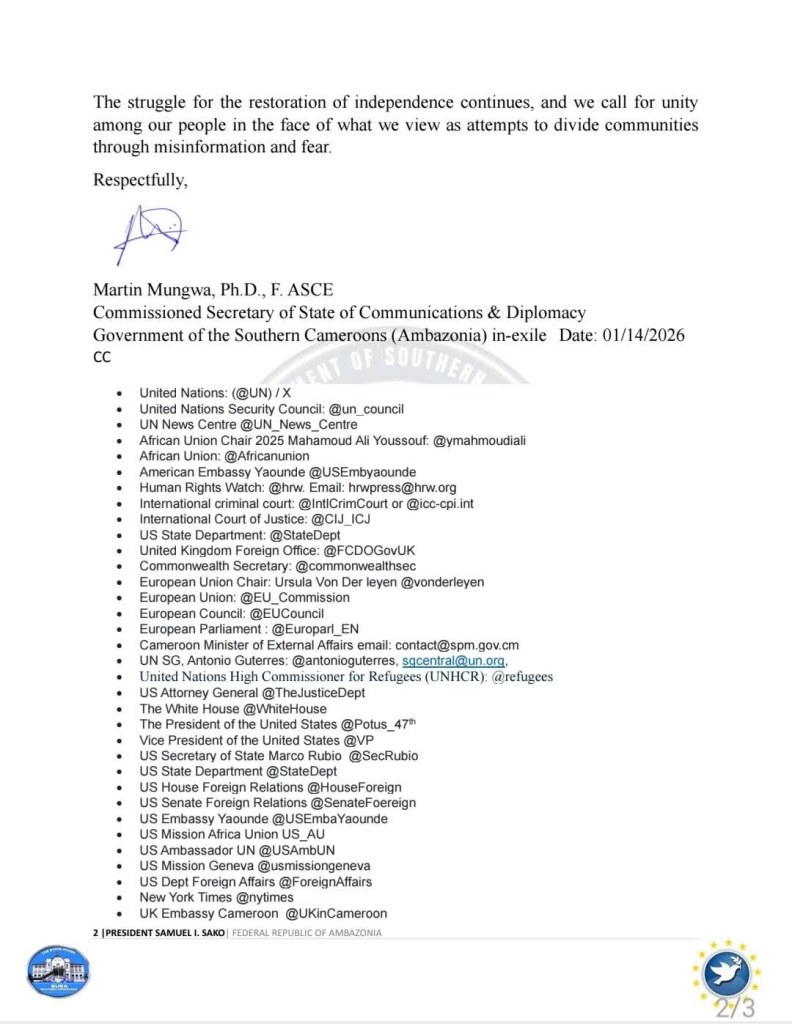
The struggle for the restoration of independence continues, and we call for unity among our people in the face of what we view as attempts to divide communities through misinformation and fear.
Respectfully,
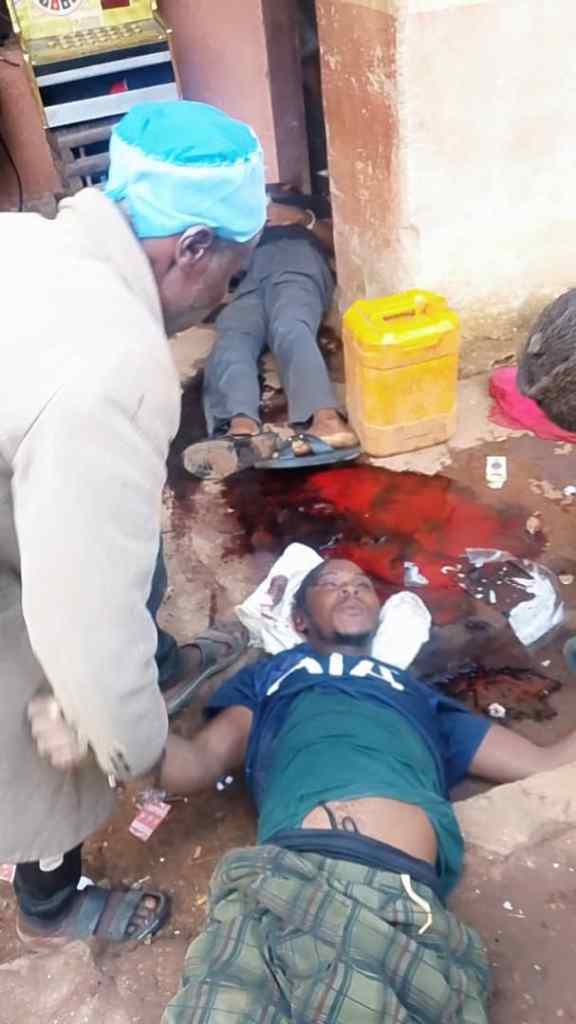
Tears of shock and anguish hit the farming community of Mforya in Bafut Local Government in English-seaking Cameroon aka Ambazonia on 6 December 2025. Eye witnesses testified that the French Cameroon military invaded the village and started targeting young men. In the end of their execution mission, at least 10 corpses were identified in street corners and bushes. In one of the massacre places, a local restaurant owner by name Ngwa Set, was shot in his restaurant alongside his customers. In addition to shattering the bodies with bullets, the French Cameroun Bulubeti soldiers also emptied their wallets. Some of the bodies were mutilated beyond recognition and were buried immediately, while others were carried to the mortuary for eventual burial. See attached video
A War Policy Rejected by Voters on 12 November 2025
Come to think of George Bush and the Republican party stealing Obama’s 2008, to continue with the Iraq war that had become unpopular to the American people. On October 12 2025, the Cameroun people overwhelmingly voted out the 94-old Paul Biya and his CPDM party in favor of Issa Tchirouma. As usual, the frail president and tribesmen stole the election. They then went after the winner forcing him into exile. Other opposition leaders were locked up and killed in jail such as Anicet Ekane.. (Below are some of the images of the killings in Mforya, bafut).


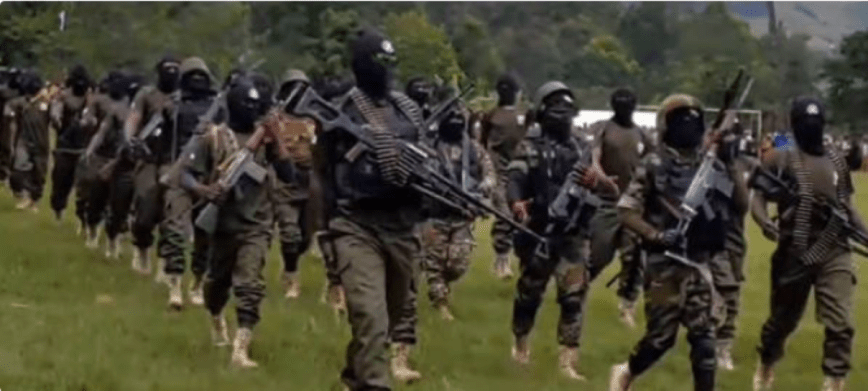
On October 6, 2016, lawyer and teacher trade unions in the Anglophone regions initiated a strike. Led by Barrister Agbor Balla, Fontem Neba, and Tassang Wilfred, they were protesting against the appointment of French-speaking judges in the British Southern Cameroons. They saw this not only as threatening the common law system in the Anglophone regions, but as part of the general marginalization of Anglophones. The strikes were supported by peaceful protests in the cities of Bamenda, Buea and Limbe. The activists demanded protection of the Common law system of the Anglophone regions, and opposed the civil law system used by the Francophone magistrate in courts in British Cameroon, thus replacing the common law system. They asked for several laws to be translated into English. The greater population inspired by Mancho Bibixy with a coffin demanded for the respect of British Cameroon’s identity. He equally questioned the neglect of the region by the French Cameroun authorities (View Here). Since 2016, more than 56,000 innocent Anglophone Cameroonians have been killed by Paul Biya.
” Il va comprendre la souffrance des camerounais (amba) pourquoi ils se battent depuis des années contre le régime dictatorial (He will understand the suffering of Camerounians. (Amba) why they have Been fighting for years against the dictatorial regime.)”
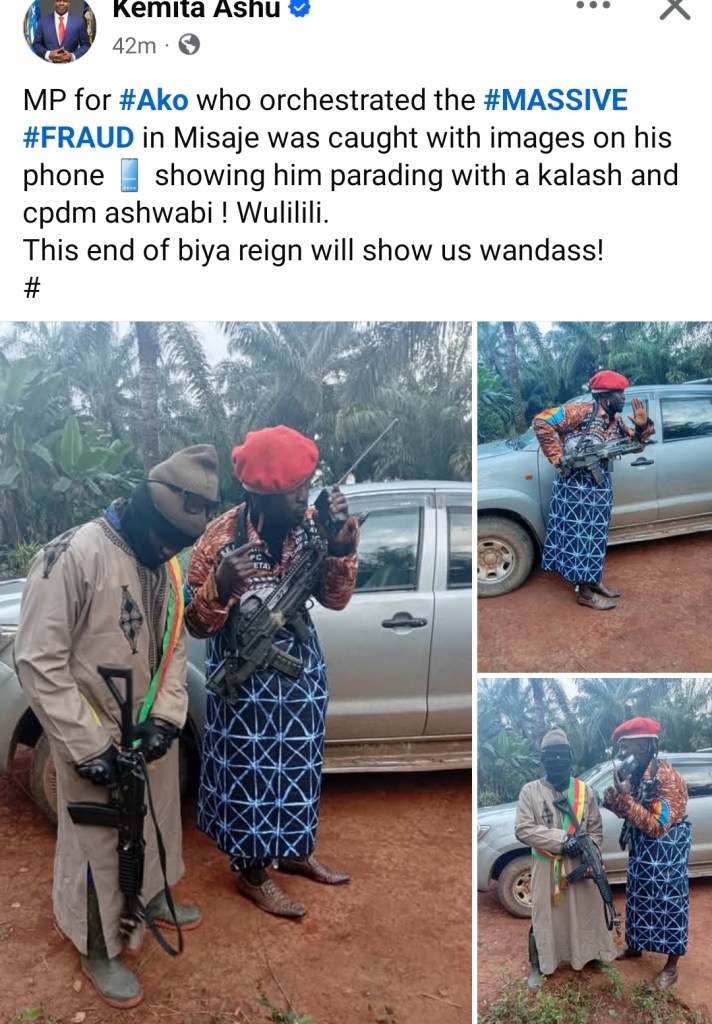
Support for English-Cameroon’s Independent fighters – Ambazonia State Army aka Amba boys has been at an all time high amongst French Cameroun citizens following their October 12 presidential elections where incumbent Paul Biya is expected to win comfortably. The support reached its peak following tentative results that show the 92-year frail man winning in all areas even where no voting took place. The apex of the support x-rayed across French-speaking Cameroun bloggers approve of the bravery of the Amba boys and even calling on them to teach a member of the ruling CPDM party a lesson following his arrest by Ambazonia State Army(ASA) in the northern zone of Ambazonia prior to the October 12 presidential election. Mr. Abe Michael, the ruling CPDM’s imposed parliamentarian for Ako and Misage local government areas in Donga Mantung County was arrested by the Amba boys and during their search and interrogation found in his cellphone gallery images of him with guns promising to execute any Ambazonia State Army soldiers.
” Pour une fois, les ambazoniens ont fait quelques choses d’important.” (For once, Ambazonians have done something important.”)
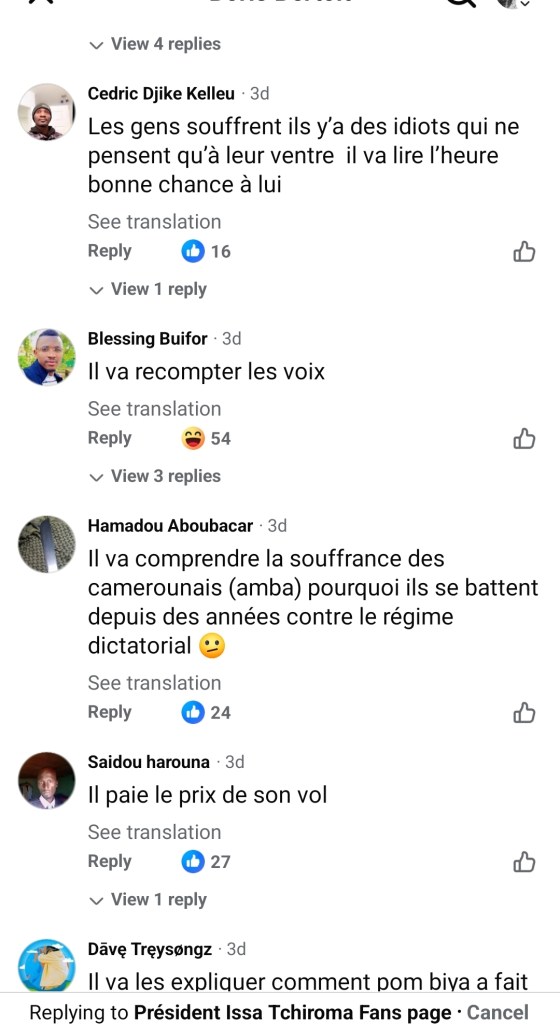
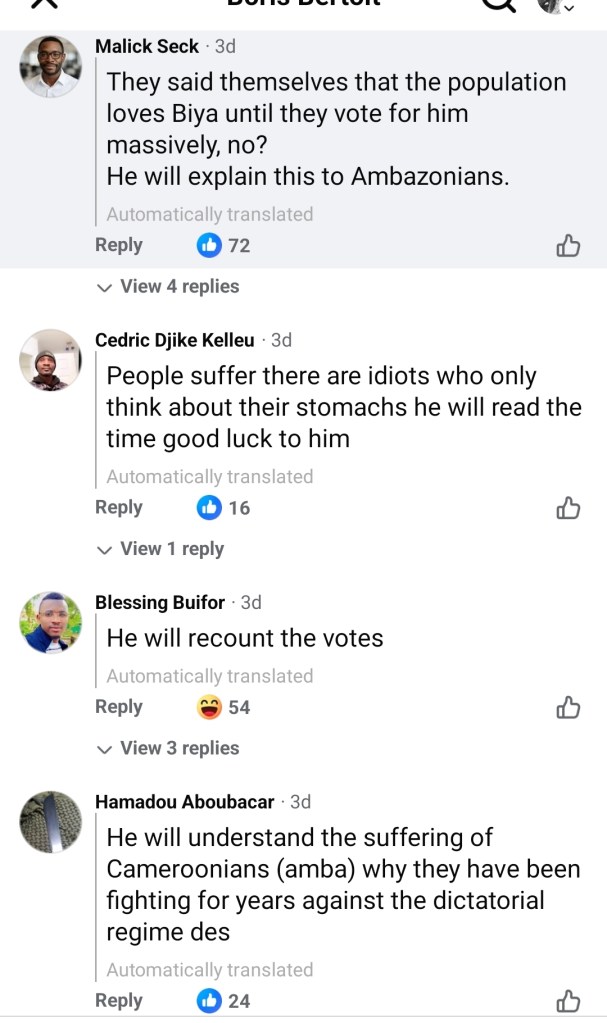
Another commentator from French Cameroun’s most prominent blogger and activist Boris Bertold comes to terms with the fight by the Ambazonian soldiers. ” Il va comprendre la souffrance des camerounais (amba) pourquoi ils se battent depuis des années contre le régime dictatorial ” : He will understand the suffering of Camerronians. (Amba) why they have Bern fighting for years against the dictatorial regime.”
Another reader was blunt about his feelings about the CPDM fraud in the area in which despite a respect of a lockdown imposed by the ASA and well-respected, the parliamentarian’s constituency voted more than 98% for Paul Biya according to figures from French Cameroun’s constitutional Council(body charged with releasing the full results of the election to the public)
“Tu va aller leurs expliquer là-bas comment le R à gagner 98%.” (“You go explain to them how the R to win 98%”) He writes
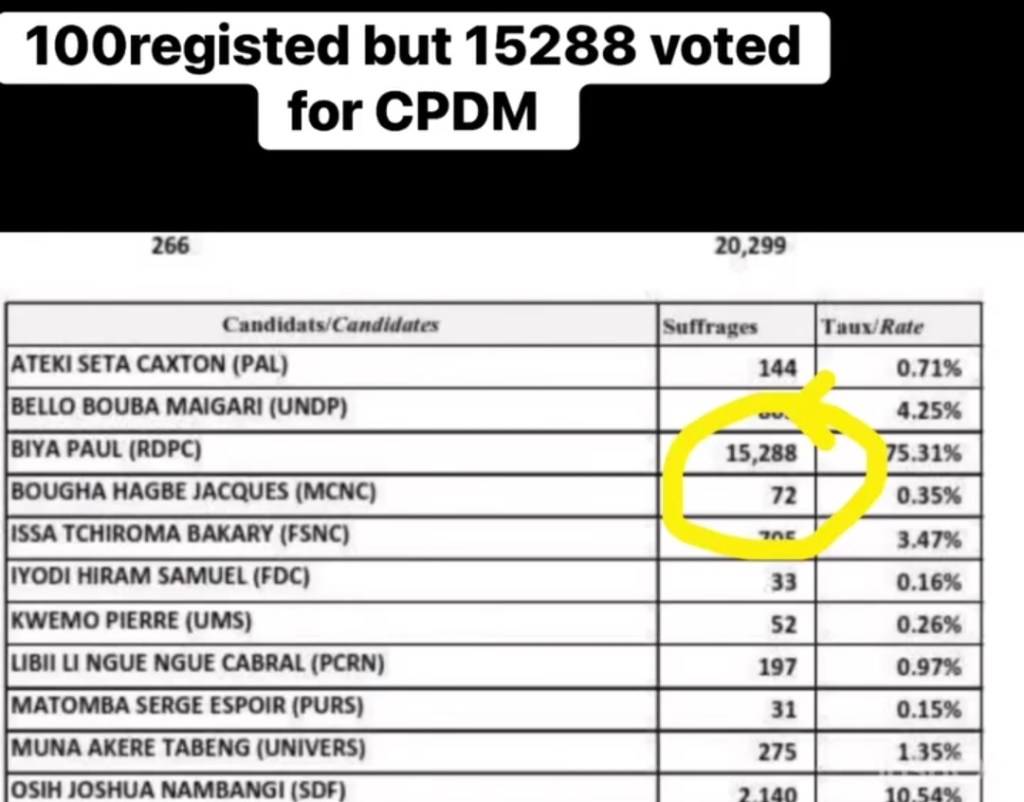

The member of parliament was reportedly killed. A member of the parliamentarian’s entourage explained his own side of why they were arrested by the Amba boys. He also revealed how greedy the MP was.
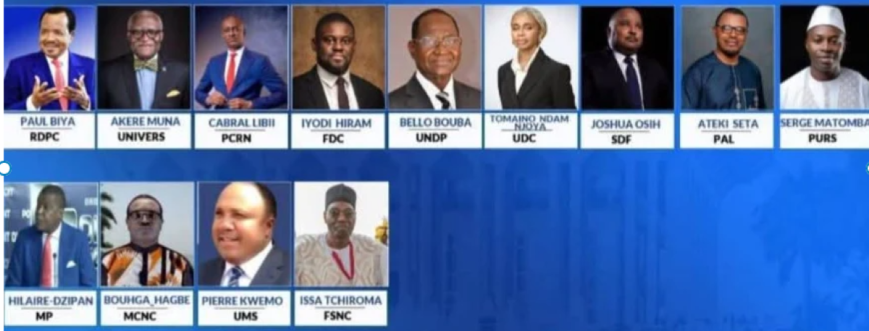
“If you believe that Biya goes to an election to lose, then have your head examined.” These are the words of a Cameroonian activists, a former prison graduate of one of Cameroun’s dungeons in the political Capital Yaoundé. Arrested several times for calling for meaningful reforms in Cameroon, many like John (whose real names are concealed for security reasons), feel the presidential election of October 12, 2025 in Cameroon is a sham. Most of the candidates are without any political representation which creates a daunting governing process. 92-year-old Paul Biya, John says has already rigged the system by postponing legislative elections, virtually short-circuiting the democratic calendar which is supposed to commence with legislative elections. Respecting the calendar would have given the presidential aspirants, most of whom are political neophytes an opportunity to build a truly organic governance process.


Senators in Cameroon are elected by indirect suffrage – by councilors, all of whom were at the end of their mandates when the senate elections were held last March 25, 2018. Of the 100 Senate seats, 70 are elected while the president appoints 30. Currently Biya’s ruling Cameroun Peoples’ Democratic Movement (CPDM), party has an overdose majority of 93 senators. To show his disdain for democracy and to have an indisputable direct influence on the activities of the body, Mr. Biya personally appointed the speaker of the Senate.
While the global media has focused on the elections, aspirants challenging the elusive Paul Biya, have equally shied away from explaining how they intend to govern, as the country’s institutions are manned by staunch loyalists appointed by Mr. Biya. This view is shared by Peter, former journalist who covered elections in Cameroon, and now lives in Canada. “Most of the so-called aspirants are enablers and “legitimizers” of the tyranny in Cameroun”. The world is talking about elections, with no regard for the conditions under which such elections will hold. Biya and his CPDM, Peter states have never won any elections in Cameroon, and will never win a free and fair election. The frustrated former journalist says he expects Mr. Biya to pay some foreign irrelevant personalities from some pseudo organizations to pronounce the elections to be free and fair. “How can they be free when he appoints every civil servant in Cameroun including governors, election officials right down to school principals?”. Such appointees Peter insists are under enormous pressure to secure victories in their various regions at all cost to maintain their positions.
While all the aspirants agree that it is time to retire the frail 86-year-old dictator, many have been vague on how they intend to democratically dismantle the tyrannical handiwork of Biya, glued in every facet of Cameroun’s life, for almost half a century, without becoming another dictator. One of the aspirants, Mr. Issa Tchirouma Bakary, has promised to free all political prisoners and reform Cameroon to prepare it for the future. These promised unilateral executive actions by Mr. Tchirouma and the others such as Bello Bouba Bello Maigari, Joshua Osih etc which run afoul democratic principles signals the impending power-grab, unlikely to be relinquished by the new “miraculous” President of Cameroun. This according to Peter, practically lays the ground work for another dictator, who will thus have to also dissolve the CPDM-controlled parliament clogged with old Biya cronies.
Mr. Biya has had a firm grip on the country for almost half a century, altering the constitution to prolong his stay. The latest 1996 constitution is far from being fully implemented, but a provision about presidential term limits has been amended. In an unprecedented move following nationwide demonstrations in which Biya’s security killed scores, On 10 April 2008, Mr. Biya’s controlled national assembly overwhelmingly amended the constitution. Apart from removing presidential term limits, the amendment prescribe immunity from prosecution for any acts the octogenarian might have committed while in office. Despite these guarantees, and now at 92, Mr. Biya is far from relaxing his brutal grip on power.
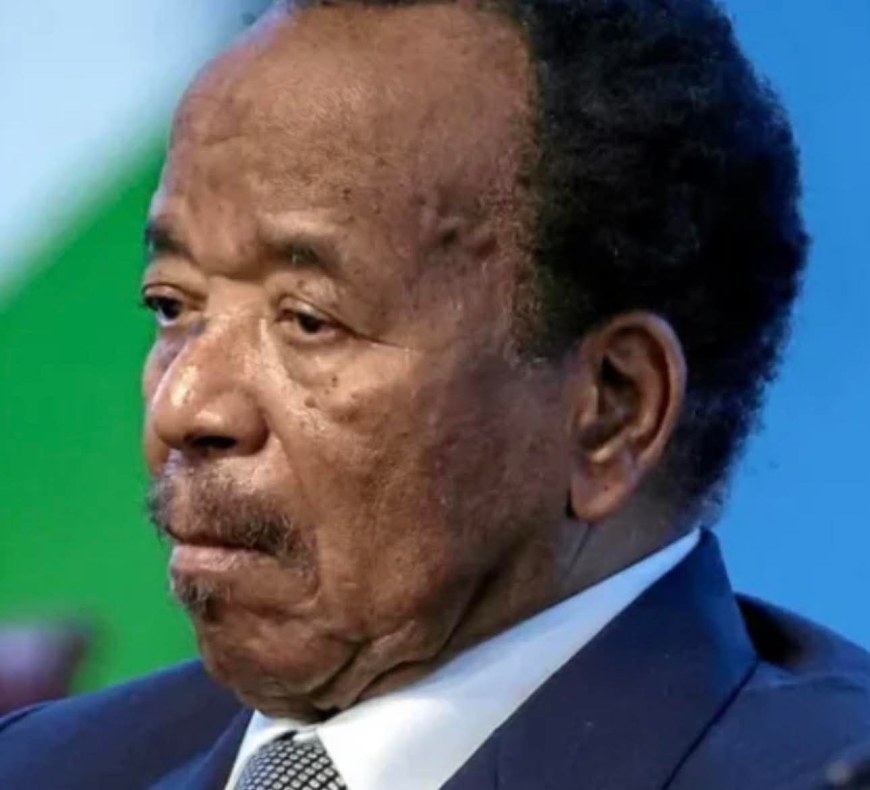
Since Mr. Biya willy-nilly accepted multiparty politics in 1990, he and his ruling Cameroun People’s Democratic Movement (CPDM) continue to choke with victory constipation at all elections while all contenders cry foul. To embellish his image globally, the old fox has embarked on lobbying and fake election observers. In 2005, while election observers such as former Canadian PM, the Roman Catholic Church under Cardinal Christian Tumi, characterized Biya’s 71% victory as “surrounded by fraud like previous ones”, the dictator was up with a big bounty for fake election observers from the US. Biya picked up the tab of $80,000 for an Association of Former Members of the U.S Congress headed by a Biya lobbyist at the time, Ronnie Shows. The association despite global assessment of a fraud election, endorsed the outcome claiming: “This is what democracy is about.” A month after, one of the six-members of the delegation signed a new lobbying contract with the dictator to feed global opinion about the democratic strides being undertaken.

Sticking to his old playbook, the octogenarian and cronies produced the same script in 2018. However, new technology was not on their side. With gross apathy and verifiable election rigging, Mr. Biya this time hired some fraudsters from the U.S ranging from farmers in Ohio to a Jewish activists/Journalist in the name of Nurit Greenger, claiming to be representing Transparency International (Click here). A claim debunked by Transparency International. When questioned on social media for the gross deception, the group’s leader was unapologetic and offensive, blocking anybody on social media who challenges their action on the Cameroun election. The state’s propaganda media houses that lied to the country about the independence of the observers have maintained sealed lips on the scam. Despite these documented anti-democratic tactics to cling unto power at all cost, the “democratic” West have stood by the old dictator failing even to formally condemn these totalitarian actions that have deprived the country of some of its citizens and meaningful progress. Mr. Biya for now is more focused on quashing dissent than the well-being of the repressed population. As one French Cameroun blogger puts it, “Putting pressure on Maduro to resign while, coaxing with dictator Biya is bad for western values”.
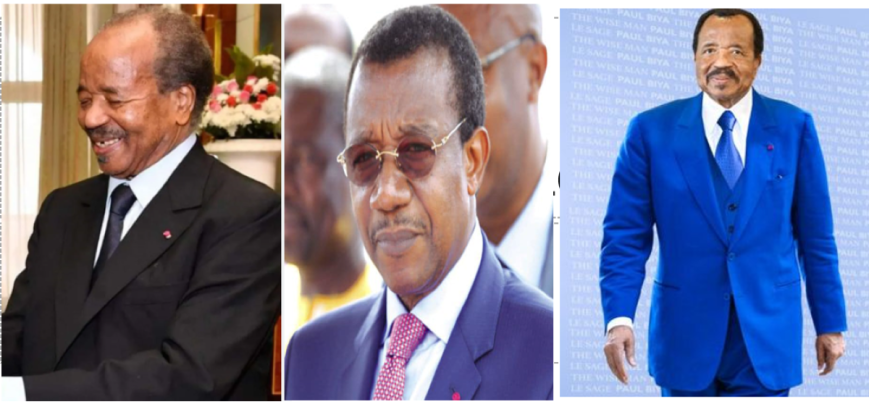
The Manufactured Image of Paul Biya: A Dictator Kept Alive by Photoshop and Fear
Life is a stage, and most leaders eventually bow out, but in Cameroon, Paul Biya and the Beti-Bulu oligarchy have refused to let go of power. At 92 years old, Biya remains “in charge” not because of vitality, legitimacy, or popular will, but because of a media machine that props him up with deceit, manipulation, and manufactured images.
For over four decades, Biya has ruled Cameroon with an iron fist(1982 till date….), outlasting eight U.S. presidents, five French presidents, and four popes. Once paraded across live broadcasts alongside his flamboyantly styled wife Chantal, Biya thrived on media exposure of wealth and excess. Today, however, his physical, mental, and psychological decline has become impossible to hide. Instead of stepping aside, the regime has turned to digital trickery.

State media CRTV has perfected the art of deception. With deepfakes and Photoshop, Biya is digitally resurrected each time he appears. Missing teeth are magically restored. A bald head becomes full of hair, a frail, emaciated body transforms into a robust figure. Every bizarre variation of Biya is pushed into the public eye—while independent live coverage is strictly forbidden.

Instead of genuine leadership, Cameroonians are served doctored images—crafted to project strength where weakness dominates. Once a visible figure at the UN General Assembly, La Francophonie, papal funerals, and other world stages, Paul Biya is now confined within CRTV’s carefully staged cameras. Every appearance is filtered, edited, and falsified before reaching the public eye. Click here to read why Biya will never appear in scenarios where crtv is not the only media present.
In the past, Biya monopolized nearly every frame—often taking up more than 98% of shots at national and international events. Today, he is reduced to split-second cameos in public appearances where live coverage is unavoidable. Viewers who are not attentive may miss Biya’s dazed, confused, and lackadaisical steps, as CRTV swiftly cuts away to other scenes or irrelevant footage in a desperate attempt to conceal the wobbling “lion man.”
The images below capture those fleeting moments—unmasking the reality of a 92-year-old leader hidden behind propaganda.
A Symbol of a Broken State
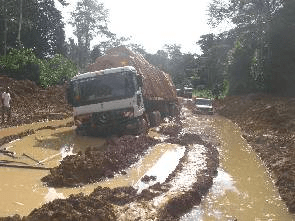
This manipulation is not harmless theater—it is a cruel distraction from a nation in crisis. While the oligarchy spends its resources manufacturing Biya’s phantom presence, Cameroon burns. In the English-speaking section aka Ambazonia, villages are torched, civilians massacred, and more than 200,000 people forced into exile. Over 53,000 lives have been lost in a conflict fueled by the same dictatorship that refuses to acknowledge reality, let alone accountability. The rest of the country swims in abject poverty exacerbated by one of the worst infrastructures in the world with daily road accidents etc.
A young image of Biya that hangs in government offices is no longer just a symbol of authoritarian power—it is a portrait of national deception. A dictator who is feared, not respected; preserved in pixels rather than principle. Updating the young picture with Biya’s current age picture is a crime punishable by imprisonment or dismissal and imprisonment. At 92 still seeking another seven-year-mandate, he is still to be physically present on the campaign field. However, his effigies are not in short supply by his followers.

At the helm of this machinery of manipulation stands Charles Ndongo, head of the country’s iron-fisted control state radio and television channel -CRTV (Cameroon Radio and Television). Charles P. Ndongo is an unapologetic Beti-Bulu loyalist. Nicknamed “the president’s journalist,” Ndongo has shadowed Biya for decades, producing glowing reports at home and abroad to polish the dictator’s crumbling image. Protected not only with legislation(Tax payer funding), policy and punitive sanctions on editorial content delivery deviation, Crtv journalists wear the batch of loyalty to Ndongo, Biya and the ruling CPDM party. Any deviations risk military arrest, torture and a transfer to Siberia/Nkondengui – the state’s congested torture prison. A French Cameroun journalist/blogger – Paul Moutila
accuses Charles Ndongo of turning the public-funded media house into, “Paul Biya’s talking drum,”, “CRTV, funded by public money, should embody pluralism. Instead, under Ndongo, it exclusively relays RDPC/CPDM propaganda, marginalizing dissenting voices and reducing the media space to a stage for political monologue.” he states.
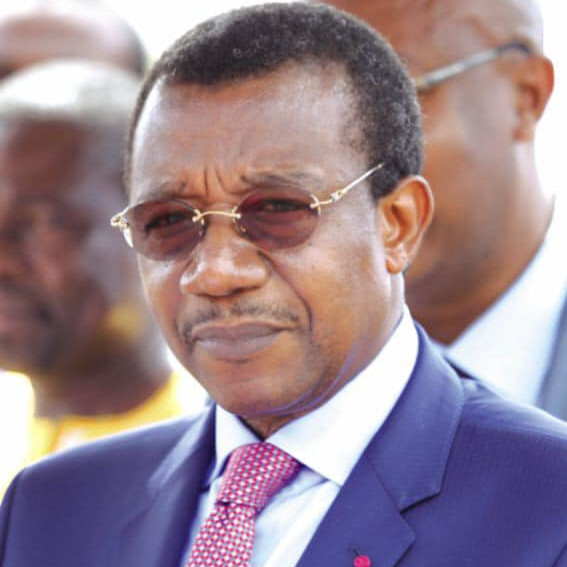

Since his appointment on June 29, 2016, by Biya himself through a presidential decree, Ndongo has assumed the role of chief propagandist, ensuring no unfiltered image or message of Biya ever reaches the public. His orchestrated broadcasts fabricate vitality where there is decline, loyalty where there is discontent, and strength where there is weakness.
Biya’s continued grip on power—and the nationwide climate of fear he commands—owes much to Ndongo’s stage-managed propaganda. His role in Cameroon’s history can only be compared to Joseph Goebbels in Hitler’s Germany: the architect of state lies, the guardian of a dictator’s myth, and the chief enabler of authoritarian survival.
The video below captures one of such manipulations of the public by Crtv during Emmanuel Macron’s visit to Yaoundé in July 2022.
This manipulation is not harmless theater—it is a cruel distraction from a nation in crisis. While the oligarchy spends its resources manufacturing Biya’s phantom presence, Cameroon burns. In Ambazonia, villages are torched, civilians massacred, and more than 200,000 people forced into exile. Over 53,000 lives have been lost in a conflict fueled by the same dictatorship that refuses to acknowledge reality, let alone accountability.
The image of Biya that hangs in government offices is no longer just a symbol of authoritarian power—it is a portrait of national deception. A dictator who is feared, not respected; preserved in pixels rather than principle.
The international community cannot continue to accept doctored photographs as proof of governance. The Cameroonian people, especially the victims of state violence in Ambazonia, deserve more than a phantom president hidden behind deepfakes.
The African Union and the United Nations must stop enabling this charade. Continued silence is complicity in the crimes of a regime that survives through both brutality and manipulation.
Paul Biya’s carefully edited image may fool television screens, but it cannot erase the truth: Cameroon is a nation held hostage by a dying dictator, a complicit oligarchy, and a propaganda machine desperate to cling to power. Real change will only come when the masks, the photoshops, and the deepfakes are stripped away—and the will of the people is finally respected.

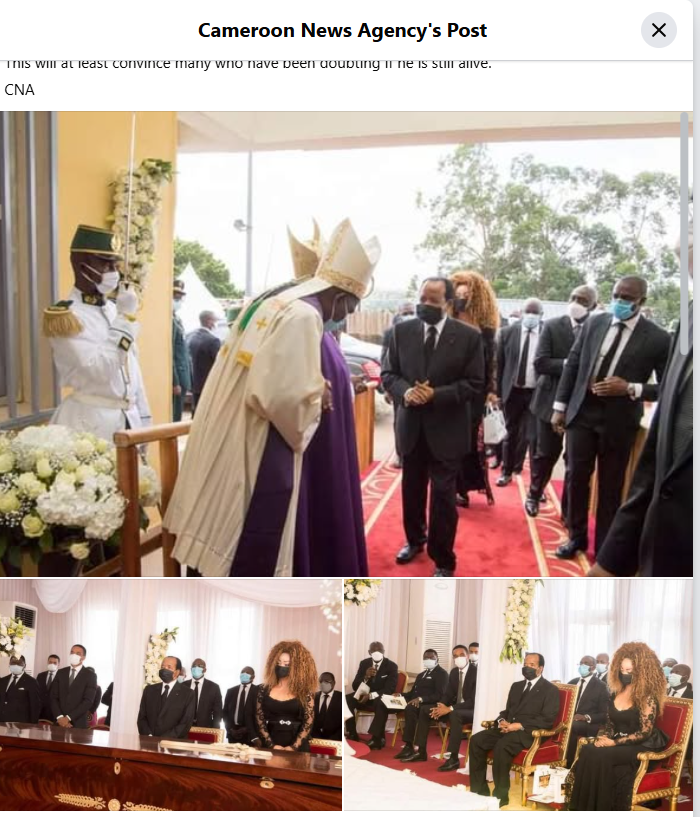
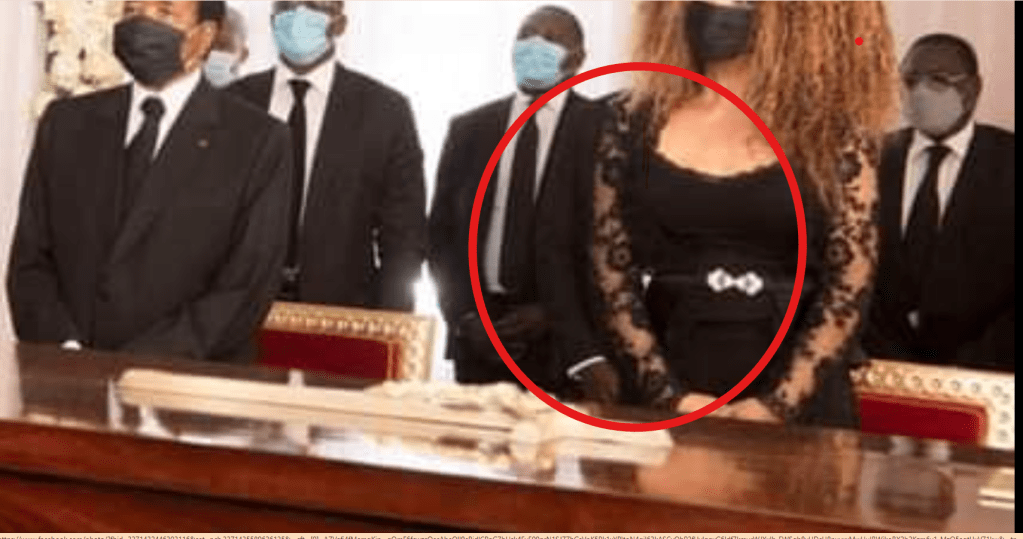
The above pictures look normal to the average viewer, but a close up of them reveal digital alterations, First the masks look faked and secondly Chantal Biya is superimposed on a male body. Take a look at the picture below: